The Language of Global Trade
Every international shipment is a negotiation.
Who pays the freight? Who covers insurance? At what point does risk transfer from seller to buyer? For decades, the answer has been found in a set of three simple syllables: Incoterms.
Short for International Commercial Terms, Incoterms are the standardised language that prevents costly misunderstandings in global trade. Without them, cross-border deals would be riddled with disputes. With them, billions worth in cargo moves daily with a shared understanding of responsibility.
The problem is that while Incoterms are universal, they are not always properly understood. A poorly chosen term can leave an exporter carrying unexpected costs or an importer assuming risks they never anticipated. That is why businesses of every size need to understand the rules that move world trade.
In practical terms, Incoterms influence far more than paperwork. They shape cost allocation, transport responsibility, insurance expectations, customs handling, operational control, and commercial risk. Choose the wrong one, and a shipment can become more expensive, more complex, and more exposed than expected. Choose the right one, and both sides know exactly where the line is drawn
What Are Incoterms?
Incoterms are published by the International Chamber of Commerce. First introduced in 1936, they have been updated over time to reflect the realities of international trade. The current version, Incoterms 2020, sets out 11 rules that define who is responsible for what in a sales contract.
Specifically, Incoterms clarify:
- Who arranges transport
- Who pays for freight and insurance
- Where risk transfers from seller to buyer
- Which party handles export and import formalities
- Which costs belong to which side during the shipment journey
Without these definitions, every shipment would require lengthy negotiation from scratch. With them, contracts are more standardised, more predictable, and more widely understood across jurisdictions.
What Incoterms do not do is just as important. They do not replace a full sales contract or determine transfer of title or ownership. Incoterms do not define payment terms. They do not solve every regulatory or compliance issue in every country. Incoterms are a framework, not the whole contract.
Why Incoterms Matter
For importers and exporters, Incoterms are not optional jargon. They are the foundation of trade contracts.
They matter because they:
- Reduce disputes by clarifying obligations
- Standardise contracts across different markets
- Prevent hidden costs, including storage, handling, and destination charges
- Define liability, so both parties know where risk begins and ends
- Create operational clarity between commercial intent and logistics execution
Imagine a shipment of chemicals moving from Riga to Singapore. Without a clearly agreed term, disputes could arise over who pays if the cargo is damaged at sea, who arranged insurance, or who was responsible for handling specific port charges. With a term such as FOB, CIF, or CIP agreed in advance, the responsibility framework is already defined.
That does not make the shipment simple. It makes it clearer.
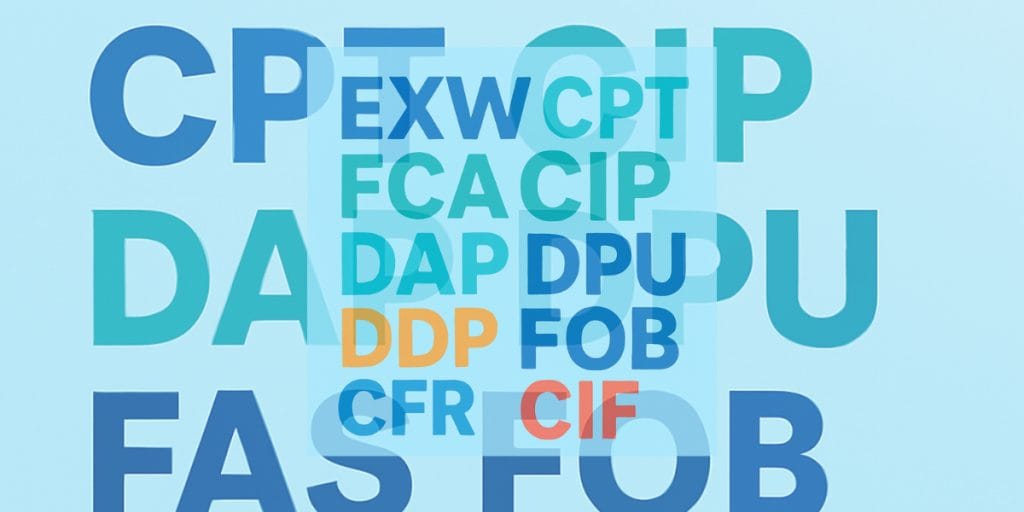
The 11 Current Incoterms (2020 Update)
The 11 current Incoterms are often grouped in two ways: by transport mode and by commercial structure.
Grouped by Transport Mode
Rules for Any Mode of Transport
- EXW
- FCA
- CPT
- CIP
- DAP
- DPU
- DDP
Rules for Sea and Inland Waterway Transport Only
- FAS
- FOB
- CFR
- CIF
This distinction matters. One of the most common mistakes in trade is using sea-specific terms like FOB or CIF for containerised shipments where a multimodal rule such as FCA or CIP would often be more appropriate operationally.
Grouped by Commercial Structure
- Group E: Departure — EXW (Ex Works)
- Group F: Main Carriage Unpaid — FCA, FAS, FOB
- Group C: Main Carriage Paid — CFR, CIF, CPT, CIP
- Group D: Arrival — DAP, DPU, DDP
All 11 Incoterms Explained
Under EXW, the seller makes the goods available at their premises or another named place. From that point, the buyer takes on nearly all responsibility, including loading, transport, export clearance, and onward movement. This gives the seller the least responsibility and the buyer the most. It may look attractive for sellers, but in cross-border trade, it can be impractical, especially when the buyer is not positioned to handle export formalities in the seller’s country.
Under FCA, the seller delivers the goods, cleared for export, to the buyer’s carrier or another named party at an agreed place. Risk transfers at that point. FCA is one of the most practical and flexible Incoterms in modern trade. It works well for container shipments, multimodal transport, and situations where the buyer wants control of the main carriage but the seller is still responsible for export handling.
FAS is a sea-only term. The seller delivers when the goods are placed alongside the vessel at the named port of shipment. From there, the buyer takes over the next stage. It remains relevant in certain bulk and non-container shipping arrangements.
FOB is one of the most widely recognised trade terms. The seller delivers when the goods are loaded on board the vessel at the named port of shipment. Risk transfers once loading is complete. It is still heavily used in sea freight, but it is frequently misapplied in container shipping. In many container movements, the cargo is handed to the carrier before it is loaded on the vessel, which is why FCA is often the better fit.
Under CFR, the seller pays the cost and freight to bring the goods to the named port of destination, but risk transfers once the goods are loaded on board the vessel at origin. This is where many businesses trip up. The seller pays for the main carriage, but the buyer carries the transit risk once shipment has occurred.
CIF follows the same structure as CFR, but the seller also provides insurance. It remains common in maritime trade, especially for commodity flows and long-distance sea shipments. For buyers, it can appear reassuring because insurance is included. But the scope of that insurance and the actual transfer point of risk still need careful attention.
Under CPT, the seller pays for carriage to the named destination, but risk transfers much earlier, when the goods are handed to the first carrier. This creates a commercial split between cost and risk. The seller arranges the movement, but the buyer bears the transit risk from an earlier point than many assume.
CIP is similar to CPT, but with the addition of insurance arranged by the seller. It is often more suitable for higher-value goods and multimodal shipments where broader risk protection is commercially sensible.
Under DAP, the seller delivers the goods to the named destination, ready for unloading. The seller handles the transport up to that point, while the buyer is responsible for import clearance and duties. DAP is often a practical middle ground. The seller offers an extensive delivery service without taking on import tax exposure at the destination.
DPU is the only Incoterm that requires the seller to unload the goods at the destination. That makes it distinct and useful in situations where unloading is operationally important, such as specialist equipment, projects, or site-delivery scenarios.
DDP gives the seller the maximum responsibility. The seller handles transport, export clearance, import clearance, duties, taxes, and delivery to the named destination. For buyers, this can feel attractive because it offers a door-to-door experience with fewer surprises. For sellers, it can be risky if they lack strong destination-market knowledge, customs capability, or local tax infrastructure.
Commonly Used Terms in Modern Trade
While all 11 terms have their place, a smaller group dominates daily commercial practice.
- EXW: Attractive for sellers because it pushes most responsibility to the buyer, but often impractical for inexperienced importers.
- FOB: Still widely used in sea freight, particularly in traditional trading environments.
- CIF: Popular where buyers want the seller to cover freight and insurance to the destination port.
- DAP: Frequently used where the seller wants to offer near-complete delivery without import-duty exposure.
- DDP: Often requested by buyers seeking maximum simplicity, but commercially dangerous for sellers who are not properly set up for import-side execution.
Related Logistics Terms: FIFO, LIFO, FILO, LILO
Beyond the ICC’s official Incoterms, shippers often encounter other operational terms that affect how cargo is handled.
- FIFO (First In, First Out): cargo loaded first is discharged first
- LIFO (Last In, First Out): cargo loaded last is discharged first
- FILO (First In, Last Out): cargo loaded earliest is discharged last
- LILO (Last In, Last Out): cargo loaded last is also discharged last
These are not Incoterms, and they are not legal trade rules in the ICC sense. They are handling and operational conventions that can influence storage, timing, loading logic, and cost expectations.
How to Choose the Right Incoterm
There is no universal best Incoterm. There is only one that best matches the shipment, the parties, and the commercial objective.
A smart choice starts with the right questions:
- Who is best placed to control transport?
- Who has a stronger customs capability?
- Who should carry the transit risk?
- Does the buyer want control or convenience?
- Is the shipment containerised, maritime, or multimodal?
- Will insurance be arranged by the seller or the buyer?
- Is the seller equipped to manage import formalities abroad?
For many containerised exports, FCA is often more practical than FOB. Sellers wanting to provide strong delivery service without tax exposure, DAP can be a sound balance. For buyers demanding a near-frictionless experience, DDP may appear attractive, but only if the seller has the infrastructure to support it properly.
The wrong term creates friction. The right one creates alignment.
Common Mistakes Businesses Make
- Assuming insurance is included when it is not
- Using outdated Incoterms in contracts
- Choosing a term that exceeds operational capability
- Using sea-only terms for container or multimodal flows
- Failing to define the named place or port precisely
- Allowing documentation to contradict the agreed commercial term
A contract may say one thing, while the bill of lading, freight booking, or customs paperwork suggests another. That is how disputes, detention costs, delays, and margin leakage begin.
The Forwarder’s Role in Incoterms
For many businesses, Incoterms can feel like alphabet soup. This is where a capable freight forwarder earns their keep.
- Advise on the most appropriate Incoterm for the shipment
- Align documentation with the chosen contractual structure
- Bridge the gap between legal wording and operational execution
- Help prevent mismatched expectations around cost, risk, and customs responsibilities
In short, the forwarder makes sure the rules of the game actually work in practice. This is one of the biggest differences between moving cargo and managing logistics properly. Transport is one thing. Structured responsibility is another.
Looking Ahead: The Future of Incoterms
- Digitalisation of trade documents
- Sustainability expectations
- Simplification for SMEs
The companies that stay current avoid being caught off guard as trade practices evolve.
Confidex: Guiding Clients Through Incoterms
At Confidex, clarity matters as much as cargo. We do not simply move goods from one place to another. We help clients understand the structure their contracts rely on, so shipments move with fewer assumptions and fewer surprises.
Advisory Support
Helping clients choose the right Incoterm for the cargo, market, and commercial reality.
Risk Management
Making sure insurance, liability, and cost responsibilities are properly understood and allocated.
End-to-End Precision
Aligning shipment execution with the actual rules that govern the movement.
Whether a client is negotiating FOB, structuring DAP, or considering DDP, Confidex helps ensure the rule selected works in practice, not just on paper.
Rules That Move World Trade
Incoterms are more than acronyms. They are the invisible rules that make world trade possible.
Guiding the responsibilities of buyers and sellers across borders, reducing confusion, and defining responsibility. They help prevent disputes before the shipment even begins.
For companies expanding into new markets, getting Incoterms right can mean the difference between costly friction and clean execution.
With Confidex, you get more than a freight forwarder. You get a partner that helps ensure the rules of trade work for your business, not against it.